
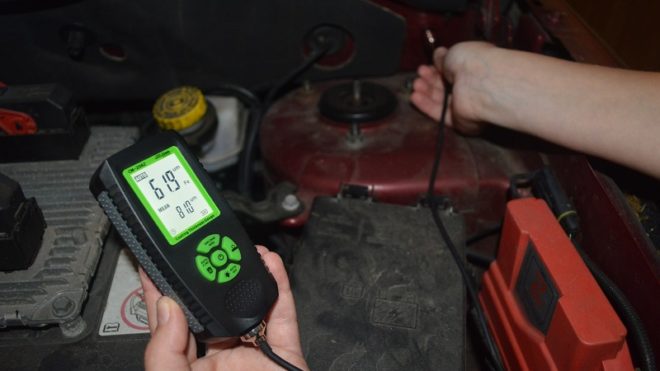
A paint thickness gauge is a high-precision measuring instrument that allows you to quickly and accurately inspect metal surfaces and determine the thickness of applied paint and protective coatings. This type of inspection is needed in many industries and manufacturing environments, which is why coating thickness gauges remain highly popular across automotive, industrial, and quality control applications.
Types of Modern Thickness Gauges
To choose a reliable, functional, and accurate thickness gauge, it is important to understand how these devices work. Depending on the operating principle and measurement method, modern coating thickness gauges can be divided into several main types.
LED Thickness Gauges
LED thickness gauges are based on a color indication principle. These instruments inform the user about coating thickness using simple color signals.
-
A yellow LED typically lights up when the coating thickness is over 1 mm
-
A red LED indicates the coating thickness is over 1.5 mm
LED thickness gauges are often used in environments where the typical protective coating range is 75–150 μm (0.075–0.15 mm). They are easy to use, but provide limited measurement detail compared to digital instruments.
Magnetic Thickness Gauges
Magnetic thickness gauges offer better technical capabilities than basic LED models. They operate using the principle of magnetic induction, which limits their use to magnetic substrates only (for example, they do not work on aluminum parts).
These devices may not always detect a simple repaint (a second layer of paint), but they are powerful enough to identify:
-
thick filler layers (body filler / putty)
-
multiple repaint layers (third or fourth repaint)
This makes magnetic gauges useful for rough inspection and basic coating checks on steel surfaces.
Digital Thickness Gauges
Digital paint thickness gauges are widely used in automotive manufacturing, car inspection, and transportation industries. They are designed to identify repainted areas and filler repairs on vehicle bodies.
Most digital models offer fast and simple calibration. If you are choosing a device for personal use, make sure the package includes a calibration kit.
The key component of a digital thickness gauge is the measuring probe (sensor). Today, there are models with:
-
a built-in (integrated) probe
-
an external (separate) probe
Both types are usually compact, fit comfortably in the hand, and are easy to carry for mobile inspections and long-distance travel.
High-Accuracy Industrial Thickness Gauges
These are next-generation coating thickness gauges designed for professional industrial measurements. They provide extremely low measurement error and can detect even minor variations in coating thickness.
Unlike handheld automotive gauges, industrial models are typically not portable, as they have larger dimensions and are designed for workshop or production use.
Industrial gauge calibration often includes more advanced modes and settings compared to standard automotive inspection models, which are usually simpler and faster to calibrate.
How to Choose the Right Thickness Gauge
The right thickness gauge depends on what surfaces you need to inspect and what measurement accuracy is required. Always consider:
-
the type of material (steel, iron, aluminum, etc.)
-
the expected coating thickness range
-
the required precision and repeatability
-
calibration complexity and ease of use
A well-selected thickness gauge helps ensure reliable coating inspection, improved quality control, and better decision-making in production and automotive diagnostics.